
A framework to maximize your effectiveness on a board
The 2 dimensions of strategic purpose and power

A friend texted me in the last few days and said, “Your thoughts about boards are about how boards should be, not actually are.” I couldn’t agree more.
But that’s part of the tension of any human organization. The board has its ideal state—how it should function. Then there is the actual state. Both can be true at the same time.
To explain further, I’d like to walk through a simple 2x2 matrix I use to consider boards.
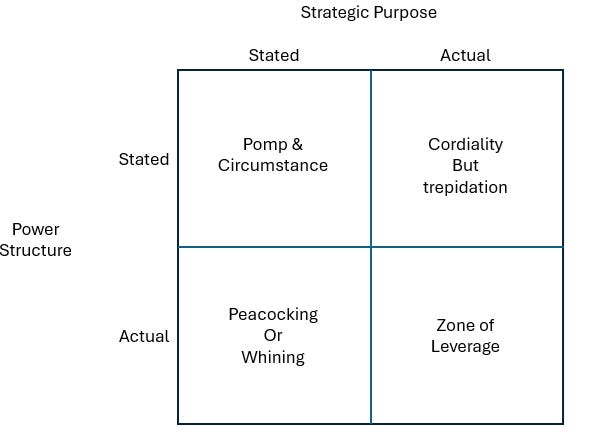
The matrix compares the board’s purpose with its power structure. The dimensions are the stated (aka ideal) and the actual. In my experience, boards have stated dimensions for each, and at the same time, there is the actual reality.
The key to being effective as a board member is to understand the difference between stated and actual for each dimension, and then position yourself to be effective when a circumstance calls for it.
A board may have:
Stated strategic purpose – the headline purpose of what the board is supposed to be addressing
Actual strategic purpose – the actual, critical strategic question that the organization should be wrestling with. It may be obvious, but it often can be hard to discuss because it risks rubbing an ego the wrong way.
Similarly, boards have two power structures:
The stated power structure – maybe there are committees and a board chair
The actual power structure – where and how decisions are made. It may not even be in the boardroom.
Which of these boxes you are operating in will tell you a lot about how to behave most effectively.
If you are operating in a place where the stated purpose of the board is on display, within the context of its stated power structure, these are places with high symbolic value. This is the pomp and circumstance, but maybe of questionable utility or pragmatism. Little of long-term strategic importance may be decided.
If you are in the zone where the board is considering its actual purpose within the stated power structure, these often are board meetings with a lot of cordiality, but board members may be exceptionally hesitant to share their actual opinions. Group cohesion is very important and often is self-reinforcing.
If you are considering the stated strategic purpose of the board but within the context of the actual power structure, the risk here is egotism and peacocking on one hand, or whining on the other. While the decision-makers are here, they aren’t focused on the right thing, for whatever reason.
If the actual power structure is focused on the actual board purpose, this is the zone of leverage. A board operating in this way can get a ton done.
So, to maximize your effectiveness on a board, you should understand these dimensions. Moreover, you need to be aware of which box you are sitting in during a given meeting or interaction. The box you are in will dictate your actions and shape your behavior.